


 Log in
 Log out
M7.5 and M7.2 Venezuela
Status: Active
| Type of posting | Posting date(EST): | Summary | Downloads |
|---|---|---|---|
| Custom Events | 7/1/2026 8:00:00 PM |

|
|
| Similar Stochastic Events | 6/25/2026 12:00:00 PM |
|
|
Custom Events | Summary
Posting Date: July 1, 2026, 8:00:00 PM
Verisk estimates economic losses for the June 24, 2026 earthquakes in Venezuela will likely exceed USD 10 billion. There is a higher degree of uncertainty than usual in estimation of the insured share of industry losses for this event, given the macroeconomic conditions in and sanctions levied against Venezuela.
ALERT™ subscribers can now download Touchstone® and Touchstone Re™ event sets, loss-based similar stochastic events (SSEs), and a ground motion footprint shapefile of the median industry loss event for impacts to Venezuela from the June 24, 2026 earthquakes from the Downloads tab for this posting on the ALERT Website. The loss-based SSEs are recommended for exposures in Venezuela. The information provided herein is strictly confidential and is solely for the use of Verisk clients; disclosure to others is prohibited unless noted in your Verisk software license.
Modeling Information and Assumptions
The modeling and insured industry loss estimate explicitly captures damage from ground shaking and liquefaction induced insured physical damage to property (residential, commercial/industrial), both structures and their contents, as well as loss of use coverages such as business interruption. The range in loss estimates reflects uncertainty in the slip distribution on the fault plane, modeled ground motion, and damage estimation. The assumed exchange rate is 1 VBF = 0.000000000000158 USD.
Clients using Touchstone to run detailed portfolios should make sure local currency values are up to date given the high inflationary environment.
The modeled scenarios contained in the Touchstone and Touchstone Re event sets and on which the loss estimates are based account for the impacts of both of the M7+ earthquakes in this sequence in a single event.
There is a higher degree of uncertainty than usual in our industry loss estimate for this event, with the following factors contributing to this:
- Verisk’s estimates are based on assumptions about take-up rates in Venezuela (the percentage of properties actually insured against the earthquake peril), which are uncertain.
- Inflation in Venezuela continues to be quite significant. The annual inflation rate over the past year is in excess of 500%, and hyperinflation has impacted the macroeconomic conditions in Venezuela significantly in recent years.
Given the additional uncertainty in industry losses, clients are encouraged to run detailed portfolios in Touchstone or market share analyses in Touchstone Re with the latest view of values wherever possible.
Verisk’s modeled insured loss estimates do not include:
- Losses due to fire-following, landslides, or sprinkler leakage
- Loss adjustment expenses
- Losses to uninsured properties
- Losses to infrastructure
- Losses from extra-contractual obligations
- Losses from hazardous waste cleanup, vandalism, or civil commotion, whether directly or indirectly caused by the event
- Losses to civil engineering (railway) risks, marine cargo and marine hull risks, aviation risks
- Transit warehouse risks
- Personal accident risks
- Other non-modeled losses
Event Overview and Impacts
On June 24, Venezuela was hit by a rare earthquake doublet near Yumare-Morón in Yaracuy state, on the Caribbean coast roughly 100 miles west of Caracas. A magnitude 7.2 foreshock struck first, followed just 39 seconds later by a magnitude 7.5 mainshock — the strongest earthquake to hit Venezuela since 1900. The shallow strike-slip rupture occurred along the San Sebastián fault system, within the broad transpressional boundary zone between the Caribbean and South American tectonic plates and was followed by more than 430 aftershocks in the days that followed.
Damage was most severe in and around Caracas and the coastal state of La Guaira, which saw an estimated 1,400 buildings destroyed. Significant destruction was also reported in Aragua, Carabobo, and Yaracuy. The Altamira and El Paraiso neighborhoods of Caracas were among the worst affected, and USGS shaking models showed severe intensity across communities including Puerto Cabello, Catia La Mar, Maiquetía, San Felipe, Los Teques, Petare, Valencia, and Baruta. Collapsed buildings trapped residents beneath rubble in multiple cities, and Venezuela's main airport in Caracas was closed and classes nationwide were suspended as the government declared a state of emergency. All told, early estimates indicate that as many as 58,000 buildings were damaged or destroyed in the event.
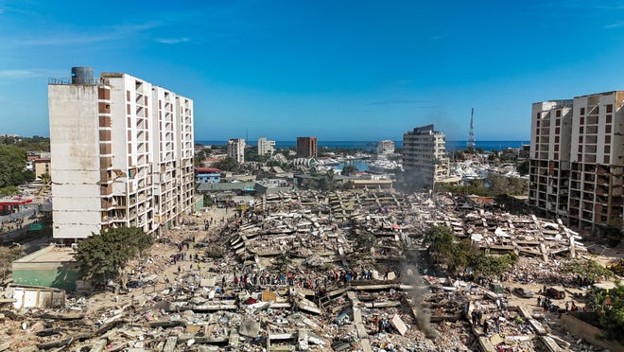
Damage in Caraballas, La Guaira (Miguel Medina, AFP, via Getty Images)
Beyond the immediate structural damage, the earthquakes set off secondary hazards that complicated the response. USGS Ground Failure modeling estimated that landslides triggered by the shaking would likely be significant in number and extent, with response teams focused on transportation disruptions, communities cut off by debris, and landslide dams that could cause downstream flooding. A tsunami alert issued immediately after the quakes was later canceled with no lasting threat confirmed.
Building Stock in Venezuela
Today, the majority of residential buildings in urban areas of Venezuela are of masonry construction. Masonry buildings typically fall into one of three classifications: reinforced masonry, confined masonry, and unreinforced masonry (URM). While confined and reinforced masonry are very common in typical low rise residential properties, reinforced concrete is the prevalent construction type in mid- and high-rise residential buildings in the urban areas.
Commercial buildings are primarily of masonry and concrete construction. Reinforced concrete construction with shear walls or frames is typical of commercial buildings and mid-to-high rise apartment buildings in Venezuela. Steel frames (moment resisting or braced) and light metal are common for industrial buildings. A large number of high-rise and tall buildings exist in large Venezuelan cities such as Caracas. According to UNESCO reports, during the 1967 Caracas earthquake most of the damage occurred in the high rise buildings (Esteva, 1968).
Mid-rise, high-rise and tall buildings in urban areas in Venezuela are commonly made of reinforced concrete shear wall with or without frames. These buildings are used both for commercial and residential occupancies (high rise and tall buildings are mainly for commercial use). In these types of structures vertical loads (including the weight of the building and the contents) are carried by both the shear walls and the frame. Lateral loads, exerted by wind or earthquake, are mainly resisted by shear walls and if moment resisting frames are available, they, too, participate in carrying the loads.
Moment resisting steel frames are another engineered construction type used in Venezuela. In Venezuela it is common to use chevron-braced frames as structural elements to provide additional stiffness and reduce the lateral displacements in earthquakes (Ugel et al., 2012). While commercial and industrial buildings are generally constructed according to stricter standards than residential structures, building code enforcement varies within and across Venezuela. Further, it is important to note that the seismic performance of buildings in Venezuela is greatly influenced by local construction practices. Building damageability is often exacerbated by poor workmanship, inadequate materials, and a lack of building code enforcement.
The Insurance Market in Venezuela
Venezuela's insurance and reinsurance sector is a relatively small, highly concentrated market operating under severe macroeconomic strain. As of September 2025, net written premiums totaled around USD 461 million, down 35.4 percent year-over-year in dollar terms even as premiums measured in bolívares surged over 200 percent, reflecting the distortions of high inflation and currency depreciation, according to the website rankingslatam.com. Only a handful of large groups dominate the market, with the top two insurers controlling nearly half of total premium volume. The regulatory environment has also been a persistent source of friction: Venezuela's 2015 Insurance Activity Law raised minimum capital requirements, increased parafiscal taxes and penalties, and was widely criticized by insurers as worsening operating conditions in the market. Historically, the state has also shown a willingness to intervene directly, including nationalizing private insurers and creating a state-owned insurance and reinsurance company.
This is the final planned ALERT posting for this event. Please contact your Verisk representative with any questions.
Custom Events | Downloads
Posting Date: July 1, 2026, 8:00:00 PM
The information provided herein is strictly confidential and is solely for the use of AIR clients; disclosure to others is prohibited.
Simulated Event Set
The simulated event set contains custom recreations of the recent Venezuela earthquakes in the model. Note these are not compatible with Verisk Synergy Studio at this time.
| Product | Version | Description | Download |
|---|---|---|---|
| Touchstone | Post-2017 | Selected set of simulated scenarios |  |
| Touchstone Re | Post-2017 | Selected set of simulated scenarios | |
Similar Stochastic Event IDs
These similar event IDs have similar industry loss footprints to the Simulated Event Set.
| Product | File Type | Description | Download |
|---|---|---|---|
| TOUCHSTONE / Re | Excel (xls) | Selected set of stochastic events, with Readme in Excel format | |
| TOUCHSTONE / Re | CSV (csv) | Selected set of stochastic events, formatted for import into Touchstone/Re | |
Additional Downloads
Note: Additional downloads related to the posting are listed below. Please use the appropriate application to view these files.
| Title | File Type | Description | Download |
|---|---|---|---|
| Ground Motion Shapefile | .zip | A shapefile of the median industry loss scenario's ground motion as measured in PGA(g) | |