


 Log in
 Log out
Japan Flooding
Status: Closed
| Type of posting | Posting date(EST): | Summary | Downloads |
|---|---|---|---|
| First Posting | 7/17/2012 6:00:00 AM |

|
First Posting | Summary
Posting Date: July 17, 2012, 6:00:00 AM
Thousands of homes have been damaged on Japan’s southern island of Kyushu following three days of extreme rainfall that produced flash floods and landslides. Most of the residents who fled record flooding in southwest Japan are returning to their homes. This event has been dubbed “Kyushu-Hokubu-Gou” by the Japan Meteorological Agency (JMA), which translates to heavy rain event for northern Kyushu.
Heavy rains have caused widespread flooding and mudslides from July 11 to July 16 after a very slow moving frontal system that developed over eastern China moved northeastward, bringing high levels of precipitation.
Heavy rain warnings remain in effect for Fukuoka, Saga and Nagasaki prefectures, according to the JMA. The heavy rainfall has broken hourly and daily precipitation records in several places. The highest levels of rainfall were recorded in the city of Aso, situated at the base of the Mount Aso volcano; precipitation rates here reached as much as 108 millimeters (4 inches) per hour, accumulating to over half a meter (19.46 in) over a 24-hour period.
As many as 500 landslides have been triggered by the event. The flooding and landslides have also been responsible for damage to as many as 100 roads and 20 bridges throughout the region. The event flooded the grounds of the famed Temple of the Golden Pavilion in Kyoto. At least 21 people have been killed so far; at least 8 people are missing.
By Saturday, July 12th, as many as 400,000 people had been ordered or advised to leave their homes over fears of flooding. By Sunday evening however, most of the warnings had been lifted allowing all but around 6,000 people to return to their homes and assess the damage. The Japanese military were involved in clean-up operations throughout the weekend, bringing supplies to stranded civilians and opening up transport routes.
Meteorological Conditions
The slow moving frontal system was part of an extratropical low. Extratropical lows typically affect southern Japan during fall, winter, and spring but are not common so far south during the summer months. These lows typically have warm and cold fronts anchored to their centers that extend radially outward similar to the the hands of a clock – usually oriented at the three and seven o’ clock positions, respectively. Heavy precipitation typically falls in the vicinity of these fronts. This particular low that formed during the period of July 9-16 had a wider separation of fronts (at the two and eight o’ clock positions) while the whole system moved slowly northeastward. The scenario resulted in the warm and cold fronts being slowly dragged in a parallel direction to Japan. Subsequently, individual rain cells began moving parallel to the fronts across Kyushu and a prolonged period of precipitation began that lasted for several days.Impact to Insurance Industry
Some of the worst of the damage has occurred in Kyushu’s Kumamoto prefecture where initial reports from the Fire and Disaster Management Agency suggest that nearly 1,200 residential buildings were inundated above floor level. In Fukuoka prefecture, a combination of landslides and flooding has damaged nearly 1,400 buildings. Infrastructure and transport links have also been heavily impacted with widespread road closures and disruption to the rail transport network, particularly in the central region close to Mount Aso. Insurance policy conditions for flood can be more complicated than those for wind damage. Flood insurance does not exist as a standalone policy in Japan. Instead, property owners can opt to purchase flood coverage as part of a standard fire insurance policy. This system evolved after larger typhoons and heavier rains in the early 1980s created a significant increase in demand for insurance. In 1984, the Japanese insurance industry added coverage for typhoon wind (and flood) as part of the comprehensive homeowners’ insurance policy. Take-up rates for flood coverage, however, remain relatively low. Flood is typically covered under comprehensive policies. Typical flood policy conditions, when inundation is above floor level, include: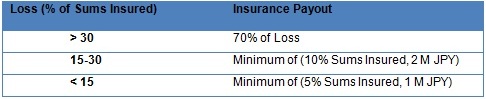
Forecast
The worst of the rainfall appears to have passed. Perhaps the greater threat would be the arrival of yet another system when soils are already fully saturated. Although typhoon Khanun is forecast to bypass the southern coast of Kyushu in a day or two, its precipitation shield could exacerbate the conditions. AIR will continue to monitor the situation and will provide updates if warranted.