


 Log in
 Log out
Hurricane Melissa
Status: Active
| Type of posting | Posting date(EST): | Summary | Downloads |
|---|---|---|---|
| Custom Events | 11/3/2025 6:00:00 AM |

|
|
| 29 October Update | 10/29/2025 11:00:00 AM |
|
|
| 28 October Update | 10/28/2025 11:00:00 AM |
|
|
| Similar Stochastic Events | 10/27/2025 10:00:00 AM |
|
|
Custom Events | Summary
Posting Date: November 3, 2025, 6:00:00 AM
Verisk estimates industry insured losses to onshore property in Jamaica from Hurricane Melissa will likely fall from USD 2.2 billion to USD 4.2 billion. The industry loss range includes estimated wind and precipitation-induced flood from Melissa’s track across Jamaica, with a small additional allowance for non-modeled coastal storm surge. Most of the modeled loss is attributable to wind.
ALERT™ subscribers can now download Touchstone® and Touchstone Re™ event sets, industry loss-based similar stochastic events (SSEs), and a shapefile of the median event (event #3) modeled wind footprint from Hurricane Melissa from the Downloads tab for this posting on the ALERT Website. The loss-based SSEs are recommended only for exposures in Jamaica. The information provided herein is strictly confidential and is solely for the use of Verisk clients; disclosure to others is prohibited unless noted in your Verisk software license.
Modeling Information and Assumptions
Included in the industry insured loss estimate are losses to onshore residential, commercial, and industrial properties and automobiles for their building, contents, and time element coverage from wind and precipitation induced flood in Jamaica. The underlying indexed industry exposure values are as of December 31, 2024. See below for additional information.
Verisk’s modeled insured loss estimates do not consider:
- Losses paid out by any sovereign or government protection programs
- Losses from Melissa’s interactions with Cuba, Haiti, the Bahamas, or Bermuda
- Explicitly modeled losses from coastal storm surge
- Losses to inland marine, ocean-going marine cargo and hull, and pleasure boats/yachts
- Losses to uninsured properties
- Losses to infrastructure
- Losses from extra-contractual obligations
- Losses from hazardous waste cleanup, vandalism, or civil commotion, whether directly or indirectly caused by the event
- Loss adjustment expenses
- The impact of demand surge
Significant uncertainty exists in the insurance take-up rates in Jamaica. The residential take-up rates in the country are less than 20% (as per a 2025 report from the Insurance Association of Jamaica) and a significant proportion of these insured properties are underinsured. A significant portion of commercial and automobile lines are also uninsured. This has an impact on the modeled loss range and where the final loss estimate from this event will ultimately land. The industry loss estimate in this posting is based on Verisk’s latest view of insured take up rates and exposure values.
Meteorological History of Melissa
The disturbance that became Melissa began as a tropical wave moving westward across the north Atlantic, eventually through the Windward Islands and into the Caribbean Sea. After initially moving westward at a brisk pace, the system slowed significantly, providing an opportunity for development of a well-defined center and organized deep convection early on October 21st, and the storm was officially named Melissa. Melissa moved slowly and erratically west to northwest over the very warm waters of the central Caribbean following formation, guided by very weak steering currents, but was initially unable to strengthen significantly due to westerly wind shear. On October 23rd, the wind shear began to weaken, enabling convection to begin developing. As a result, Melissa became better aligned vertically, and, turning more northward, and strengthened the following day.
Exceptionally warm sea surface temperatures and low wind shear ignited a period of rapid intensification on October 25th, with Melissa’s maximum sustained winds increasing from 70 to 140 mph in just 18 hours. After a brief pause, intensification resumed, and while moving generally westward, Melissa attained Category 5 status early on October 27th. After turning to the north-northeast, the system later strengthened further, with maximum sustained winds of 185 mph and a minimum central pressure of 892 mb as it began its final approach to Jamaica on the October 28th. That afternoon, the storm made landfall near New Hope in Westmoreland Parish in Jamaica at its peak intensity.
The hurricane weakened inland over the mountains and emerged off Jamaica's north coast at Category 4 strength, headed toward Cuba. The system weakened to a Category 3 hurricane soon thereafter. After briefly re-strengthening to Category 4, the hurricane made landfall in eastern Cuba on October 29th with maximum 1-minute sustained winds of 120 mph. The mountainous terrain of Cuba led to additional weakening, with the storm's sustained winds falling to low-end Category 2 strength by the time Melissa moved back offshore. The system then weakened further to Category 1 strength, while beginning to accelerate toward the northeast, passing near Long Island in the Bahamas that same afternoon. After re-strengthening to Category 2 intensity once more, on October 30th, increasing wind shear and decreasing sea surface temperatures caused Melissa to weaken to a Category 1 hurricane again and commence extratropical transition upon its closest passage to Bermuda on October 31st.
Melissa set several records over its lifecycle. It was the most intense hurricane to make landfall in Jamaica since recordkeeping began and was tied for the most intense hurricane landfall globally since record keeping began by minimum central pressure (along with the 1935 “Labor Day” hurricane) and by maximum wind speed (with the 1935 Labor Day Hurricane and 2019 Hurricane Dorian in the Bahamas). It was also the most intense storm of 2025 generally and is third only behind 2005 Hurricane Wilma and 1988 Hurricane Gilbert for lowest minimum central pressure in an Atlantic hurricane to date.
Hazard and Damage Observations
The residential building inventory in Jamaica is dominated by masonry construction to the tune of almost 70% and approximately 30% wood framed buildings. Roofs are mostly low to pitched flat and the construction practices are fairly informal with very little to almost no professional input. Under these circumstances, significant damage and in a number of cases near total destruction of buildings is expected in the landfall area when a major category 5 hurricanes blowing 185 mph, like those experienced from Hurricane Melissa is expected.
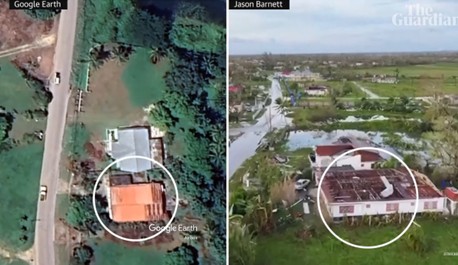
Many neighborhoods in St. Elizabeth parish, where Melissa made landfall, including Black River, Barbary Hall and adjacent areas are reporting significant damage with 80-90% and in some cases 100% of the buildings seeing roofs completely destroyed. The figure below shows before and after images from the Black River area showing near total destruction.
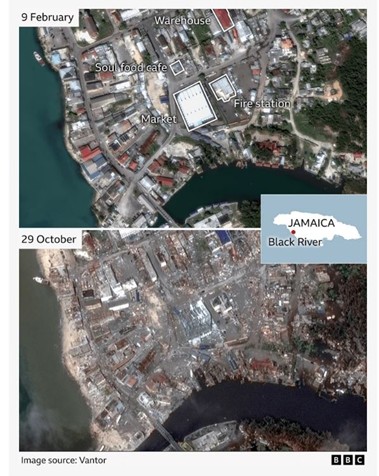
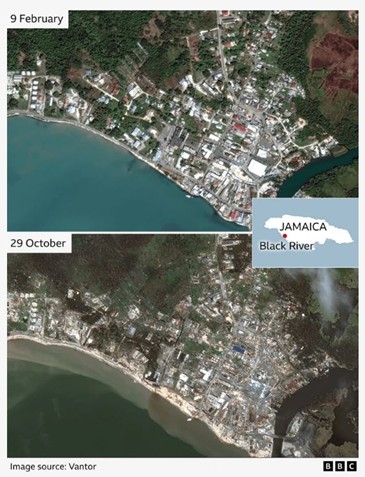
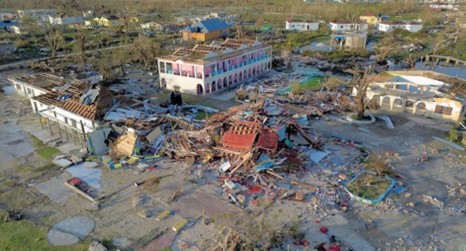
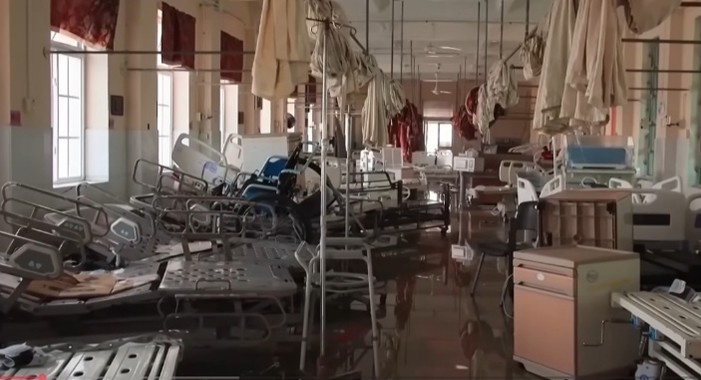
Non-engineered residential buildings and engineered commercial buildings saw damage to roofs alike. From residential homes to commercial buildings including grocery stores, gas stations, airports, hospitals, buildings serving all sorts of functions were impacted and saw significant damage. While wind and wind driven rain caused widespread damage, many neighborhoods reported precipitation flood induced damage as well. The images below illustrate damage across buildings in many such neighborhoods.
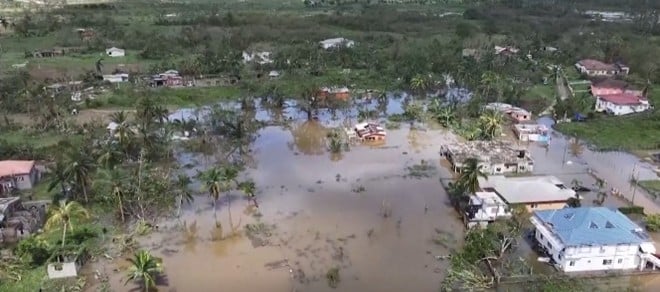
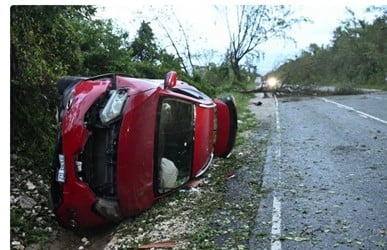
Major damage from wind, storm surge and precipitation induced flooding was also reported in northwest Jamaica in Montego Bay. This area is popular with tourists and includes many resorts which sustained major damage following the storm. While wind played a major role in dictating damage in Western Jamaica, lots of reports of flooding were reported in eastern Jamaica as far east as Kingston which is the capital and the population heavyweight on the island.
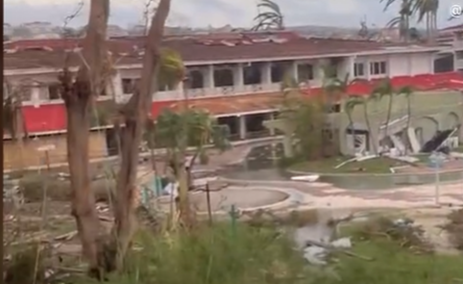
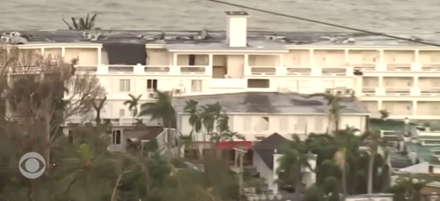
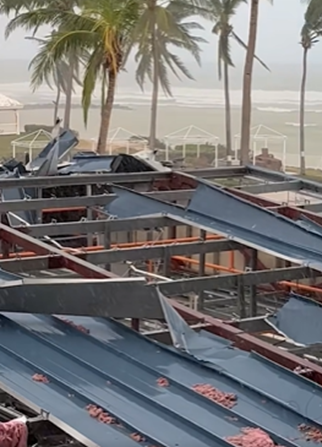
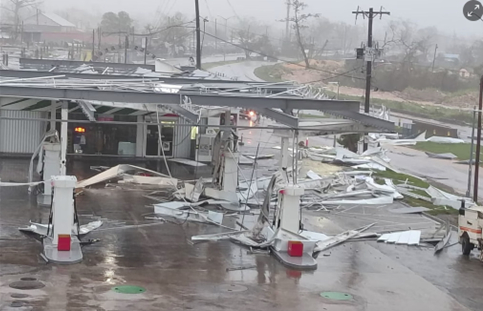
Figure 2: Severe damage to resorts, gas station in Montego Bay, Jamaica following the passage of Hurricane Melissa
Building Codes in Jamaica
Given the significant amount of wind damage seen along the path of Hurricane Melissa, it is important to put this damage in perspective with building codes in Jamaica. The first building code in Jamaica known as Kingston and St. Andrew Building Act dates back to early 1900 and was mostly a legal document describing the building regulation and governance in the region. Fast forward to 1985, the Organization of Eastern Caribbean States (OECS) published the Caribbean Uniform Building Code (CUBiC) which provided wind design force requirement for several Caribbean islands including Jamaica, and was potentially used by some engineers for design and construction of buildings in Jamaica, although it was not legally mandated.
In 2003, the Jamaica Institute of Engineers developed Jamaica’s first National Building Code which was an application document to the 2003 edition of the Uniform Building Code (UBC) with necessary adjustments and commentary to meet the needs of Jamaica’s built environment and hazard characteristics. The application document included a basic design wind speed map for Jamaica to facilitate engineers to properly design buildings for wind forcing. The basic design wind speeds for areas such as Black River and Montego Bay which bore the brunt of Hurricane Melissa’s winds were set to 130 and 125 miles per hour (3-sec gust), respectively. The winds that these areas experienced from Hurricane Melissa exceeded some of the design winds in these areas and therefore significant damage to the built environment should be expected. While Jamaica’s National Building Code was initially not legally enforced, the passing of Jamaica’s Building Act in 2019 is expected to improve the enforcement and rigorous application of this building code and enhance the resilience of Jamaica’s built environment moving forward, particularly given the magnitude of damage that Hurricane Melissa inflicted.
This is the final ALERT planned for Hurricane Melissa. Please contact your Verisk representative with any additional questions about this event.
Custom Events | Downloads
Posting Date: November 3, 2025, 6:00:00 AM
The information provided herein is strictly confidential and is solely for the use of Verisk clients; disclosure to others is prohibited.
Simulated Event Sets
These event sets contain five custom modeled scenarios for Hurricane Melissa's impacts in Jamaica, allowing for uncertainty in key model parameters such as radius of maximum winds and minimum central pressure. All scenarios follow the official NHC track.
| Product | Description | Download |
|---|---|---|
| Touchstone | Selected set of simulated scenarios |  |
| Touchstone Re | Selected set of simulated scenarios | |
Loss Based Similar Stochastic Event IDs
These stochastic events were selected as best matches to the insured industry loss footprints generated by the custom modeled scenarios in the Simulated Event Set.
| Product | File Type | Description | Download |
|---|---|---|---|
| Touchstone / Re | Excel (xls) | Selected set of stochastic events, with Readme in Excel format | |
| Touchstone / Re | CSV (csv) | Selected set of stochastic events, formatted for import into Touchstone/Re | |
Additional Downloads
Note: Additional downloads related to the posting are listed below. Please use the appropriate application to view these files.
| Title | File Type | Description | Download |
|---|---|---|---|
| Hurricane Melissa Modeled Wind Shapefile | .zip | A shapefile for the median loss scenario wind footprint from the Simulated Event Set | |
| Hurricane Melissa Custom Modeled Scenarios Information | .xlsx | Event parameters and modeled insured industry loss estimates for the five custom scenarios for Hurricane Melissa found in the Simulated Event Sets. | |